Strengthen Your Garage Door
03/12/2026
Make Resilient Upgrades | Strengthen Your Home • Hurricanes | Tornadoes
Why Does it Matter?
Decades of post-storm damage investigations after hurricanes, tornadoes, and severe thunderstorms reveal that more than 90% of house damage in severe wind events begins when garage doors separate from their mounting, collapse, or cave in due to wind pressure and/or windborne debris impacts. The doors are critical because they cover your home's largest and weakest opening.
The good news is that the National Institute of Standards and Technology (NIST) analysis and key post-tornado academic and other post-hurricane damage investigations indicate that strong, reinforced garage doors can serve a vital and protective role in severe winds. NIST found that homes with intact garage doors following a severe wind event are more likely to retain their roofs and the walls adjacent to the garage. The correlation between intact garage doors and undamaged roofs remained effective at wind speeds up to 135 mph. This means that in a low Category 4 hurricane or a high EF-2 tornado, keeping your garage door in place can protect your home from costly, progressive damage and even total destruction.
What do I Need to Know?
What makes one garage door stronger than another?
- Metal thickness (gauge) of the door to resist pressure and impact of windborne debris.
- Number and strength of mounting brackets, mounting boards, hinges, and connectors holding the door and track to the wall and the ceiling.
- Horizontal struts that strengthen and reinforce the door against buckling.
- Locking mechanisms on the sides to help keep the door in place in high wind events.
What type of doors are best for high-wind locations?
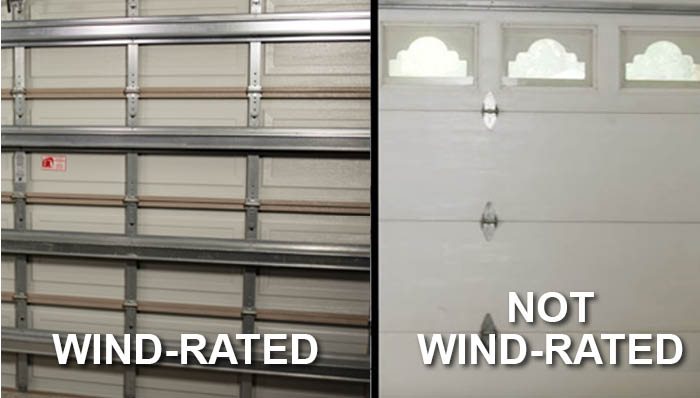
- Wind-rated and impact-resistant doors that are tested and approved for use in your location. Wind-rated is good. Impact-resistant is better.
- Single-car garage doors usually resist wind forces better than two-car garage doors.
- Doors without glass or glazing are better than those with glass or windows unless the glass is impact-resistant.
How do you know if your garage door is impact-rated or wind-rated?
Determining whether garage doors are wind-pressure rated or impact-resistant can be challenging without proof-of-compliance labeling (typically a yellow or white sticker listing pounds per square foot, or PSF).
If your door does not have a sticker, take a picture of your door and contact a local garage door dealer or the manufacturer for assistance.
Where do I Start?
Strengthen your existing garage door through regular maintenance and enhancements
- Contact a local garage door or certified garage door installer for an annual garage door “check-up” including:
- Inspect the mounting brackets and connectors and make sure the screws are tight, and the track is not loose.
- Add mounting brackets and connectors if you only have three on each side.
- Replace rusted pins or worn-out rollers, and make sure they are balanced.
- Verify the lifting system functions as designed, especially if you modify the mounting.
Note: It is essential to have a licensed and insured garage door professional perform this work to preserve door balance and the performance of safety protections.
Replace and upgrade your garage door with a wind-rated or impact-resistant version
- Contact a garage door distributor or dealer and consider purchasing a wind-pressure-resistant or impact-resistant garage door.
- The costs will vary depending on the type of doors you choose and the installation cost where you live. However, you can expect to spend as little as $500 more for this type of door than for a non-wind-pressure-rated or non-impact-resistant door.
Note: Your home insurance company may offer annual discounts for these types of garage doors.
Build temporary, Do-It-Yourself 2-by-4 wood braces to reinforce your non-wind-rated door before a hurricane arrives
- This is the lowest-cost solution and will cost approximately $150 for materials plus more for installation unless you are handy and have the necessary tools for the job.
- Do not forget to release the lift system when you have temporary panels in place. This will avoid accidental deployment and potential damage if you use the garage door opener while the panels are in place.
Note: This is an emergency, temporary measure and should only be used when a National Hurricane Center hurricane watch or warning is in effect.
Release your lift system and deploy lock your garage door locks ahead of expected severe wind events, including hurricanes and tornadoes
- If your door has locks on each side, you can use them to increase your wind resistance ahead of the storm.
- If you are leaving for an extended vacation, deploying your locks can provide additional home security value.
Note: Not all garage doors include locking mechanisms, but a certified garage door professional can add them for a modest cost.